Combating malnutrition by promoting optimum utilization of soybean at the household level

May 30, 2018
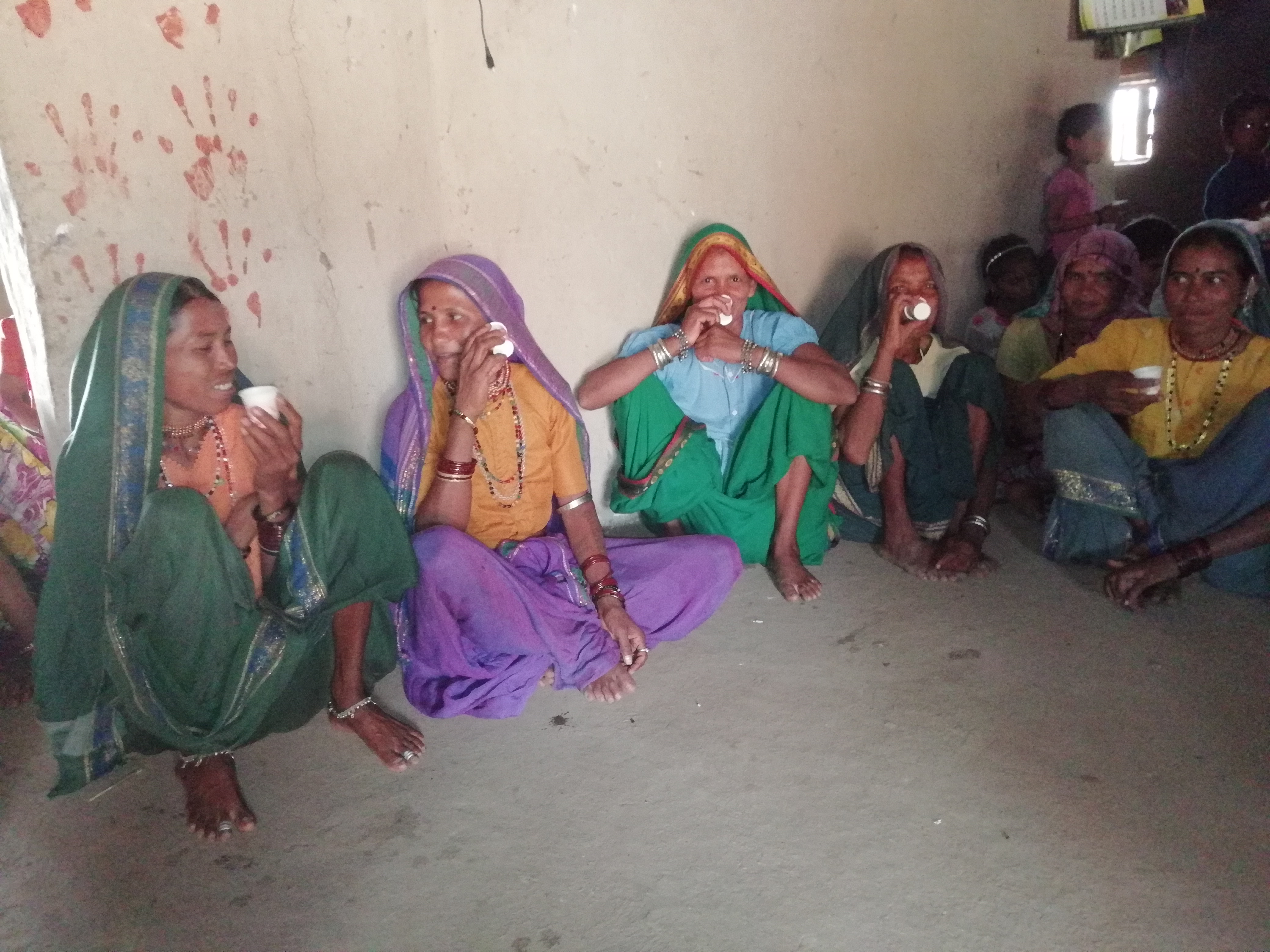
Villagers being offered to taste soya milk
As per National Family Health Survey-4 data, only about 10 percent of the country’s total children are receiving a suitable diet. The malnourished and undernourished child population of India is higher than many underdeveloped countries, which questions the growth of the nation as a whole. To combat this, the government has launched the National Nutritional Strategy aiming at eradicating malnutrition by 2022 through their ambitious program “Mission Malnutrition Free India-2022”.
In order to accelerate the process and aid to these existing macro level policies, at times smaller but target oriented approach at micro-level can also yield substantial output. This has been manifested by a young SBI Youth for India fellow, Shalmali Ghaisas who is posted at Rojanimal village located in Barwani district of Madhya Pradesh.
The district of Barwani features among the top 115 backward districts of India according to a report published by the government thinktank Niti Aayog in 2017. The district has a rank of 35 in poverty and as low as 8 in health as per the rating done by the Niti Aayog.
Shalmali, a post graduate student of France’s Pantheon-Sorbonne University felt the need to understand the nuances of how things work at the ground level for her thesis on “Manufacturing sector wage differentials between skilled and unskilled labor in India’. She realized she needs to come back to India and gather field experience and hence opted for a gap year."
While scouting for a suitable platform which will help her get this exposure, she chanced upon SBI Youth for India Fellowship, which provides a 13-month long experience in rural development. After joining the fellowship, she was posted with the ground partner the Aga Khan Rural Support Programme, India (AKRSP – I) in the Barwani district of Madhya Pradesh. During the initial days, Shalmali met the community members to identify the problem they faced and subsequently brainstorm to come up with a robust solution. “The most interesting part of the fellowship is that fellows are given a substantial amount of time to interact with the community to understand the existing lacuna and then identify the area which needs intervention given the feasibility. It was quite challenging as the solution had to be substantial enough to be implemented in the 13-month period”, said Shalmali.
After the initial survey, Shalmali realized she needs to work on the malnutrition level among children in the village. The World Health Organisation (WHO) cites that malnutrition, in all its forms, includes undernutrition (wasting, stunting, underweight), inadequate vitamins or minerals, overweight, obesity, and resulting diet-related noncommunicable diseases.
Her primary data comprising of 120 household pointed to the fact that 70% of the sample size reveals moderate malnutrition. None of her sample had a Body Mass Index (BMI) of above 15.
On further probing she realised important components missing in the diet of the children in the village including vegetables and milk. Her next course of action was to find a sustainable solution to the problem of malnutrition and it involved interacting with several community members. On speaking to the villagers, she realised that one crop which was grown in abundance in the area was Soya bean which is a species of legume and a source of cheap protein.
124578.jpg)
Shalmali depicting how to make soya milk
“The villagers did not use the soya for their own consumption, they grew it as a commercial crop. This is when I realized that the villagers can use soya milk as a substitute for milk and get some of their protein requirements from it. I started with formulating a plan on how to go about with it", added Shalmali.
On speaking to experts from the field she decided to teach the villagers how to make soya milk as well as products like “okara”, tofu and whey and advocate for its incorporation in their daily diet. She started with learning how to make soya milk and made about 4 litres every day. The following day she would carry the same to village meetings or community gatherings and distribute it in paper cups without mentioning what it was. This helped her to ascertain acceptability among her target beneficiaries.
For the first phase of implementation, 16 beneficiary households were chosen in Rojanimal village where women were willing and had showed maximum response. To ensure sustainability various recipes of okara, tofu and whey products were demonstrated to the beneficiaries. Pamphlets with pictorial depiction were also distributed among the beneficiaries.
Electric mixers and hand driven grinders were allocated on a cost sharing basis to empower them to make the soya products themselves. Out of 16 households, 8 showed behavioural change by adopting soya in their daily diet. This was verified by surprise visits carried out by Shalmali herself. Half her target audience showed positive behavioural change within 13 months of her fellowship, which in itself is an achievement for Shalmali. This intervention has caused a curiosity among other community members and slowly they are willing to consider ‘Soya’ more than just a cash crop. In order to further validate the usefulness of Soy milk, she will be measuring health parameters of children from these families and recording their progress from before and after including Soy in their diet.
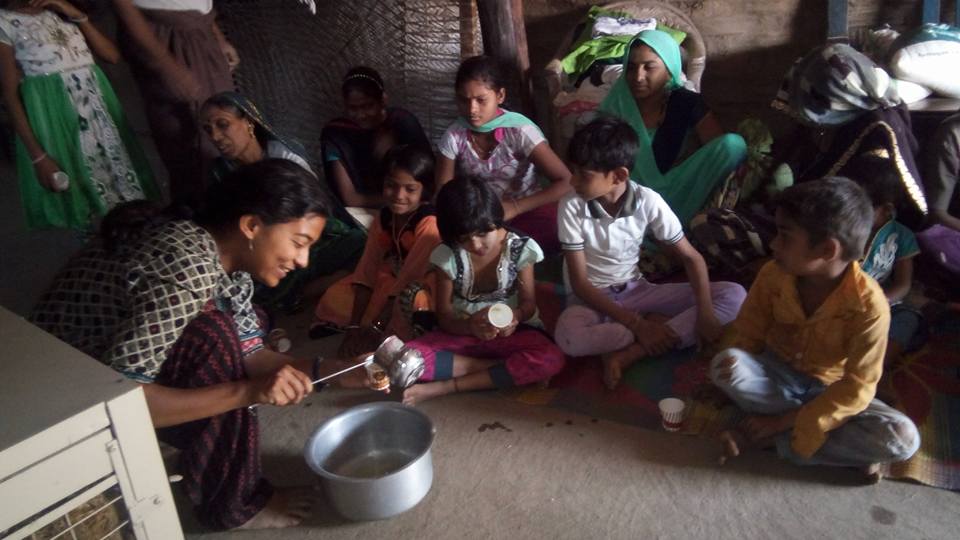
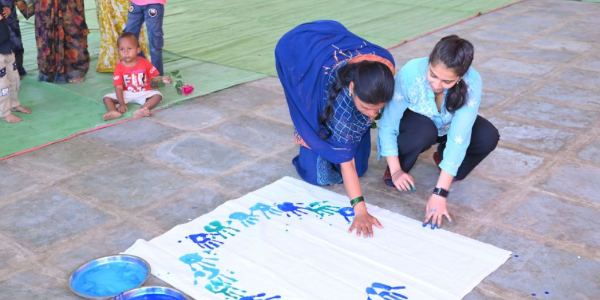
Shalmali interacting with children
Shalmali calls her project “Optimum utilization of soybean at the household level”. The success of her project lies in the fact that she believed in working along with, what the community knows and further building on what they have.
On interacting with her, she concluded by saying that she is taking back a microscopic understanding of Agricultural Economics from this project and the fellowship helped her understand ground realities much better – an area in which she had no exposure earlier. “I went out of my comfort zone and tried to bring about a significant change in an important domain like malnutrition. Before joining the fellowship, being an urban kid, I have only come across the theoretical part of issues like these, resulting in a skewed understanding of grassroot problems. Only when I landed in Barwani district, I realized the magnitude and severity of the situation where several factors needed intervention,” she added. What started as exploring unexplored territory, over a period of time became a mission for her.
Do you want to be part of the fellow bandwagon and contribute to the development of rural India?
Apply online here to make this year, your #YearForChange.
Applications close on 5th of June.
Impact-Story is a series on development and CSR interventions leading to some impacts on the ground. If you have a project, innovation or intervention that has changed the lives of a few people or a community, please share a brief note at csr@ngobox.org. Our Team will get back to you after validating the information for a detailed coverage.


More Stories

CSRBOX is India’s leading CSR knowledge and impact intelligence driven media platform for the development community. It serves as an enabler, encouraging collaboration and partnerships between CSR stakeholders. Here, we connect and inform over three million professionals through our online platform, and bridge information gaps by providing a range of services for Corporate, NGOs and Social enterprises, to enhance their capacities, aid collaboration, plan projects, publish knowledge resources, conduct research, amplify their reach and much more.
Submit CSR News
Please submit your CSR news, CSR impact story ideas to us. Our Team will get back to you within 6-12 working hours. You can also email us at info@csrbox.org© Renalysis Consultants Pvt Ltd. All Rights Reserved | Powered by NGOBOX