More power to her: CINI collaborative efforts under Kanyashree Prakalpa and SABLA

September 11, 2020
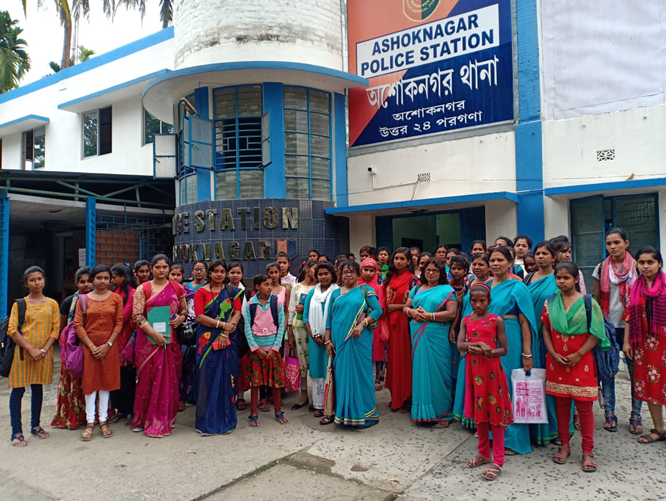
Exposure visit of adolescent girls to Police Station Aww training, Purulia
For most Indian girls life changes at adolescence. Pivotal bodily changes, amplified social expectations, and household responsibilities narrow the spectrum of opportunities available to them. The transition from secondary school or entry into the labour market is coupled with pressures of marriage and childbearing thus stymying their social, economic, and educational development, and threatening their sexual reproductive health.
In light of this multifaceted gender-based polarization, the Department of Women and Child Development & Social Welfare piloted a scheme in 2015-18 that was a merger of the Kanyashree Prakalpa and SABLA schemes, across six districts (Purulia, Malda, Nadia, Cooch Behar, Jalpaiguri, Alipurduar). This convergent program offered services beyond just nutritional care, where schoolgirls were mainstreamed into education and were able to avail Kanyashree's cash benefits. The SABLA scheme was re-named as Schemes for Adolescent Girls (SAG) and extended its focus on out of school girls in all the 23 districts of West Bengal. CINI a non-profit institution supported the Department as the State Technical Partner of the program and even ran direct intervention blocks.
Child in Need Institute (CINI) is a humanitarian organization founded in 1974, in South twenty-four parganas in West Bengal whose roots lie in treating malnourished and ill children in villages and slum areas. In the recent past, CINI underwent a methodological shift in its policy and action by adopting a human rights-based approach that is multi-pronged, venturing into the realms of health, nutrition, education and child protection in community care. With 'deeper interconnectivity' at the heart of its philosophy, CINI acts as a facilitator by engaging local development actors – the community, service providers and elected representatives – in a process aimed to strengthen good governance with and for children and women while collaborating with state institutions to run and monitor schemes effectively.
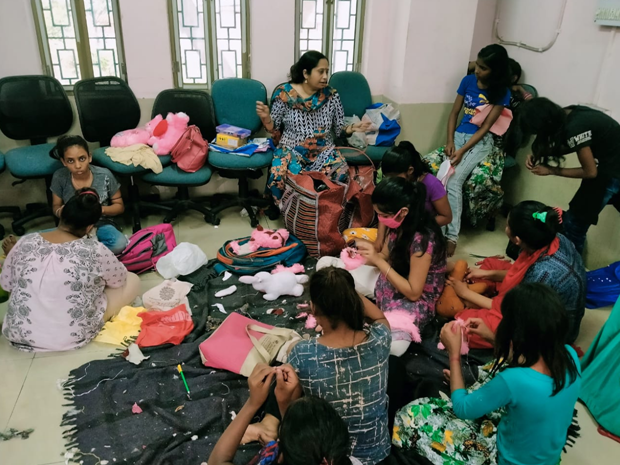 Vocational Training on Soft Toys Making, Kolkata.
The promise of reimagined schemes such as SAG and KP lay in their broadened horizons – catering to a plethora of systemic issues such as infant and child mortality, gender discrimination, gender-based violence, malnutrition, early marriage and pregnancy, maternal mortality and risk of HIV/AIDS to truly empower the girl child. The convergent schemes catered through CINI to a total of 7,56,120 adolescent girls aged 11-18 both in and out of school in 21 districts of West Bengal. Tremendous efforts have yielded in large scale impact documented across the old districts of Kolkata, Purulia, Malda, Nadia, Coochbehar, Alipurduar and Jalpaiguri.
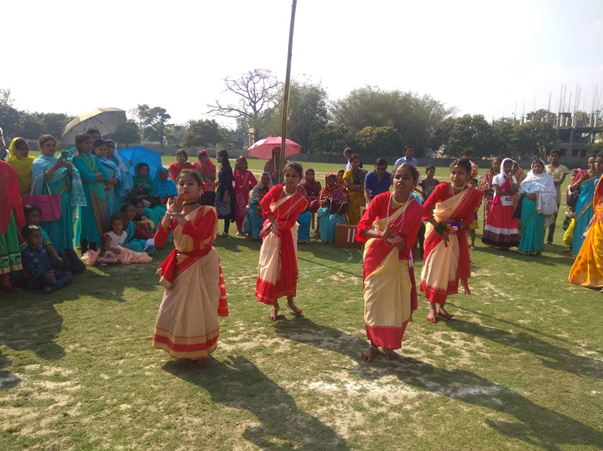 Cultural program by Adolescent Girls, Malda.
Under the thematic area of Education, the program results have reflected an increase in the enrolment rate of girls going to school. The few that remain un-enrolled are tracked and collective efforts are being made to get them enrolled or link them to institutions that can provide vocational training for them. There has also been a positive shift in the perspectives of parents post the Kanyashree and Sabla schemes, who now understand the implications of early marriage on their daughters and have become active participants in the education process. The convergent schemes have also brought about a heightened awareness regarding child marriage as a social evil prevalent among the community.
Within the purview of Health and Nutrition, there has been immense improvement in health and hygienic practices among adolescent girls. Under SABLA (SAG)-KP, regular meetings are held with girls to discuss relevant health-related topics, share queries, and learn. The SABLA kit is a resource tool used to teach girls about sexual reproductive health including menstruation, nutrition, anemia, and hygienic practices. There has been an increase in the number of girls using sanitary napkins while procuring them at low cost continues to remain problematic. The girls that use cloth pads are taught how to wash and re-use the pads in hygiene fashion. Under SABLA the girls also receive regular check-ups for anemia and are taught to check for signs and symptoms. IFA and de-worming capsules are provided at the schools and ICDS centres for the girls to ensure there is no iron deficiency. The importance of nutrition and a balanced diet has also been ingrained into the beneficiaries. This concept has been introduced to the girls using an innovative 'nutrition flag' tool – highlighting the utility of white, saffron, and green colored food in a highly nutritious diet.
Another area of focus for CINI has been to inculcate a spirit of leadership and confidence within the adolescent girls so that they can make informed decisions and report violence prevalent within the community. 'Sakhis' and 'Sahelis' conduct sessions with assistance from CINI Facilitators and AWW. This has resulted in girls demonstrating leadership within the community where they have rescued their peers suffering domestic violence, registered reports at the police station, and even helped economically vulnerable people in the community avail timely medical treatment.
One of the most impressive outcomes of the convergent schemes has been the strengthening of the community-based monitoring system. A social resource map has been curated to identify vulnerabilities such as school dropout, malnutrition, severe anemia, gender violence, possible child marriage cases, and cases of children with special needs. The Kishori card has been used to monitor the self-growth and health status of the beneficiaries. CINI also ensures height, weight, and BMI accounts are maintained for the beneficiaries. The adolescent girls have also taken the initiative to track vulnerability relating to children and adolescence within their community.
Another area of improvement has been that of accessibility and visibility across services and institutions. AGs are informed and make more effort to avail Anwesha Clinic's counseling services for severe problems. Despite pertinent quality and supply issues, take-home rations have also been made available in selective areas for the community. Adolescent girls have emerged as active participants in the community and take initiative to teach dance, yoga, etc, and support young children with their studies. The talent of these girls has also been on display at showcases and centers where they host dance, music, painting, handicraft, theatre, and poetry-related displays and performances.
To further cement this emerging sense of synergy and community leadership and collaboration, CINI has introduced a good practice of 'Adolescent WhatsApp groups'- a space where adolescent girls from different districts come together to carry out discussion on a vast range of topics on their health, nutrition, education, sexual reproductive health and life skills through small IECs. Stakeholders and support groups such as AWW, ASHA, teachers, Anwesha Counsellors are also present within the groups to better facilitate and supervise meaningful discussions and learning. These WhatsApp groups have proven to be very useful during the current COVID pandemic where adolescent girls have been able to inform ASHA, ANM, or even Panchayat Members about vulnerable and high-risk members of the community such as pregnant women or families affected by the cyclone Amfun. This has allowed the Panchayat and local community members to respond quickly and effectively.
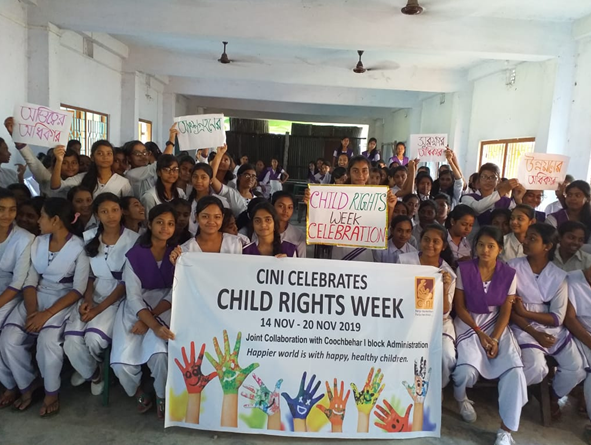
Child Right's Week Celebration at Coochbehar I block
CINI and the convergent schemes of SAG and KP have been a stepping stone towards renewing the Government's commitment towards the empowerment of adolescent girls in India. The methodology of collaborative leadership adopted by the program has enabled non-profits to merge their expertise and deep community ties with state infrastructure and resources to help significantly improve the quality-of-services delivered and create demand for these services at a community-level, thus kickstarting a wave of change. Ultimately, promoting adolescent girls' empowerment is critical for both mitigating the effects of the current crisis and building resilience against future shocks. It can also set a generation of girls on a successful path to growing their human capital and participating and contributing in meaningful ways to the economy and themselves.
If the story resonates with you, please share
Impact-Story is a series on development and CSR interventions leading to some impacts on the ground. If you have a project, innovation or intervention that has changed the lives of a few people or a community, please share a brief note at shilpi@csrbox.org. Our Team will get back to you after validating the information for a detailed coverage.


More Stories

CSRBOX is India’s leading CSR knowledge and impact intelligence driven media platform for the development community. It serves as an enabler, encouraging collaboration and partnerships between CSR stakeholders. Here, we connect and inform over three million professionals through our online platform, and bridge information gaps by providing a range of services for Corporate, NGOs and Social enterprises, to enhance their capacities, aid collaboration, plan projects, publish knowledge resources, conduct research, amplify their reach and much more.
Submit CSR News
Please submit your CSR news, CSR impact story ideas to us. Our Team will get back to you within 6-12 working hours. You can also email us at info@csrbox.org© Renalysis Consultants Pvt Ltd. All Rights Reserved | Powered by NGOBOX