Networking Impacts on Marginalised Sections in South-Central Zones

September 2, 2020
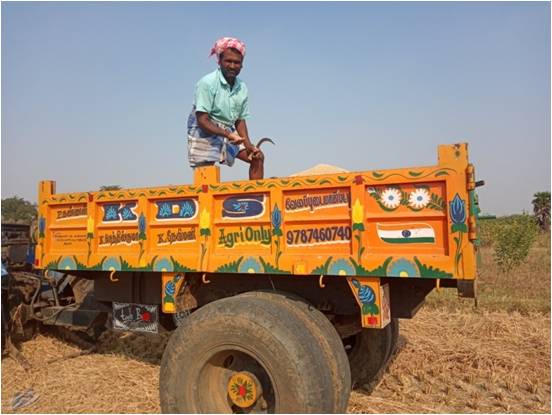
Panchagavya manure training has brought abundance on fields
South Central India Network for Development Alternatives (SCINDeA) is a Network of 14 organisations that primarily focuses on health, education, water and sanitation, livelihoods and sustainable agriculture.
This reputed pioneering networking NGO has been providing continuous support to NGOs in the three states of Tamil Nadu, Andhra Pradesh and Karnataka since the last 24 years. The Network primarily works with the Dalits, tribals, fisherfolk, quarry workers, slum dwellers, small and marginalised farmers and ex-miners. This professional spectrum itself speaks of the instability of jobs, while telling a tale of a hand-to-mouth living styles.
With little or no savings at hand, many who belong to below poverty line, aredependent on Nature and its natural course for most of their living conditions. This is where the SCINDeA Network comes handy. Extending a hand of solace, the beneficiaries have been evolved in a manner that sustains continuous local support via localized NGOs. This strong support of SCINDeA enables sustainable development programmes focused on gender equity, human rights and environmental protection through people’s participation in order to help its core beneficiaries.
SCINDeA builds empowered movements in South Central region of the country by enhancing the capacity of staff of the partner organisations of the Network and enables evolving sustainable development programmes focused on gender equity, human rights and environmental protection through people’s participation. Trainings at grassroot levels come handy in such interventions.
The objective of the agriculture project is to work with the farming communities primarily from a nutrition-based approach in their sustainable agricultural practices covering farmers, young, pregnant and lactating mothers and adolescent girls. The objectives are achieved amongst the most under privileged communities that strengthens and support each other into a common goal of promoting sustainable development through people’s participation.
SCINDeA’s objective to promote nutrition-based approach in agriculture practices through trainings and practical guidance has built capacities of farmers and their collectives in production, value addition and collective marketing of nutritious food products. K. Senthil and many like him from the socially excluded sections of the society feel empowered and resolved to actively participate in nutrition based sustainable agriculture.
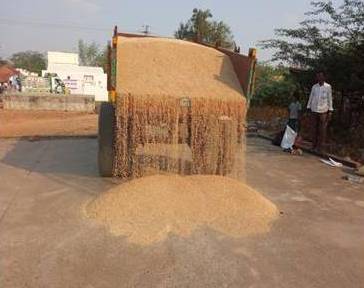 Rich harvests after training intervention and implementation
K. Senthil from Sethurapatti village is a member of the farmers groups in his village. After attending the village level training towards improvement of his agricultural produce he learnt the organic methods of paddy cultivation along with the aided benefits. The methods include the preparation and usage of panchgavyam which is a soil nutrient made up of five ingredients namely cow urine, cow dung, cow milk, curd and ghee. Panchagavyam is known to boost immunity and promote plant growth.
Having been trained in the preparation of panchagavyam, Senthil applies it to the soil in his land. He said, “earlier on when I used chemical fertilizers, I harvested only 45 rice bags that were not even tasty. By cultivating paddy organically, I was able to save Rs. 5000/- and spent only Rs. 4000/-. I am thankful to SCINDeA for guiding me to adapt to organic method of paddy cultivation.”
Besides training farmers in sustainable nutrition based organic practices SCINDeA also augments the diet and nutritional diversity among the farmer families with special focus on children and young mothers in the selected villages by engaging local institutions. The participative methodology of SCINDeA is of prime importance. The methodology of capacity building of farmers is undertaken at the production level while the nutrition education of pregnant and nursing mothers and mothers of young children is done at the consumption level.
This two-pronged approach in 40 villages in 3 blocks of Trichy district, Tamilnadu has helped to balance the income needs of the farmers and the nutrition needs of women and children alongside. In the project, 2400 farmers and 400 young, pregnant and nursing mothers were identified and sensitised on the importance of nutrition in overall development of their children. The mothers were taught through demonstrations how to prepare nutrition rich millet recipes, fresh juices, salads and snacks.
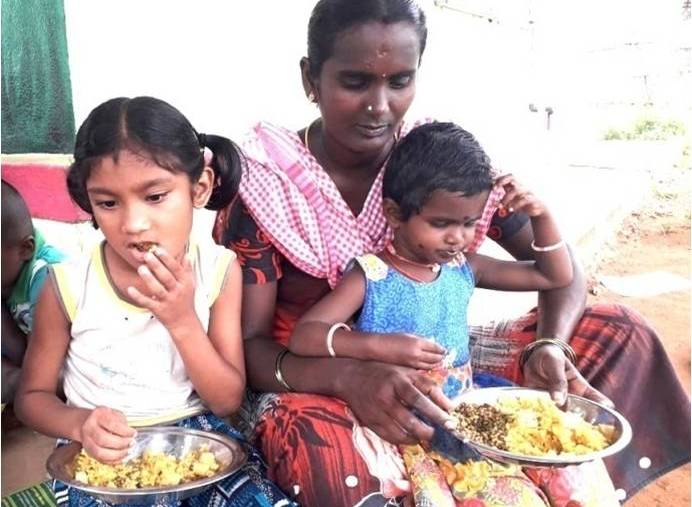 Young mothers and children happy with nutrition-filled platefuls
The story of Priya speaks volumes where SCINDeA provides alternative perspectives and relevant expertise to young mothers. Sathya Priya from Kalingapatti village says, "We come from a poor family and we have not been able to feed our children with nutritious food." However, through regular meetings held at the nearby SCINDeA Centre, Sathya Priya was able to learn more on nutrition and child health and the link between the two. She says “the practical sessions on preparation of different types of nutritional food and its importance helped me to make some good decisions.”
The training programmes for young mothers has taught this simple village young mother to prepare nutritional food required for her children and family without spending any extra money. "If I were to buy all these items, I would have to spend an amount of Rs. 1000 to have all this. But now I easily get them on free of cost to promote a healthy family of my own. Thanks to SCINDeA."
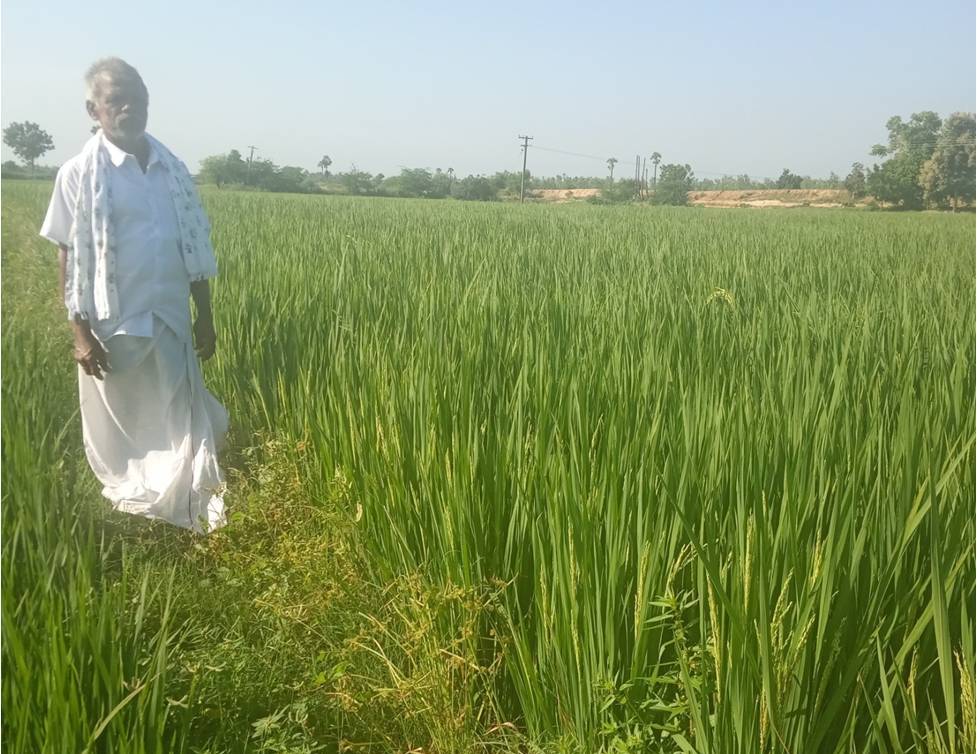 Fish and Vegetable compost works wonders for farmers
Over the years SCINDeA has developed expertise in understanding the local opportunities and constraints and providing solutions. This is done by building capacities of communities that creates a meaningful dialogue among those who are disadvantaged. Yet another local beneficiary who belongs to farming community from Sethurapatti village is a simple farmer N. Govindamoorthy. As a participant, the SCINDeA approach has taught him and other farmers in his village how to do agriculture in a sustainable manner at the village level. Through the various training programmes, he has learnt how to prepare vermin compost, fish amino acid and use them as organic manure.
Fish amino acid is composed of rich organic matter and plant nutrients like amino acids, protein and carbohydrates, which help to meet any nutritional deficiency in plants. Farmer Govindamoorthy is happy while stating, "I am able to save Rs. 1400 which I would otherwise have spent on chemical fertilizers." His delight continues when he speaks of preparing the mor karaichal. It is a mixture of one litre sour buttermilk and five kilograms of coconut. “I just spent Rs. 150 only," he says. Expressing gratitude to SCINDeA programmes, he is overjoyed to report, "I sincerely thank SCINDeA for giving me the great opportunity to practice the organic method of agriculture, it is definitely going to be useful for our future generation."
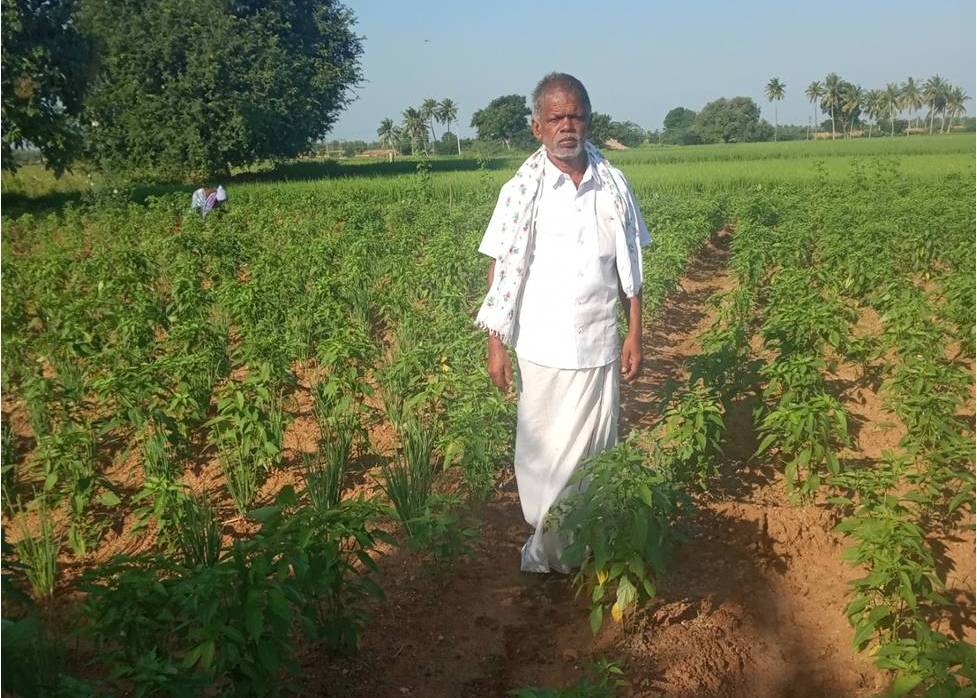 Sustained agricultural practices pay rich dividends
Farmers like Govindamoorthy and K. Senthil are only two among the 2400 farmers who have benefitted from the various intensive training programmes in 5 modules on soil management and water conservation, managing crop diversity that include pulses, oil seeds and the like, managing pests without pesticides for food safety and quality improvement, value addition of millets etc.
Be it promoting nutrition-based approach in agriculture practices, build capacities of farmers, young mothers and adolescent girls in production or augmenting diet and nutritional diversity among the families, SCINDeA Network is ever ready to engage with local institutions and promise a better future to marginalized and vulnerable communities.
The project is supported by Herbalife International through Charities Aid Foundation (CAF)
If the story resonates with you, please share
Impact-Story is a series on development and CSR interventions leading to some impacts on the ground. If you have a project, innovation or intervention that has changed the lives of a few people or a community, please share a brief note at shilpi@csrbox.org. Our Team will get back to you after validating the information for a detailed coverage.

More Stories

CSRBOX is India’s leading CSR knowledge and impact intelligence driven media platform for the development community. It serves as an enabler, encouraging collaboration and partnerships between CSR stakeholders. Here, we connect and inform over three million professionals through our online platform, and bridge information gaps by providing a range of services for Corporate, NGOs and Social enterprises, to enhance their capacities, aid collaboration, plan projects, publish knowledge resources, conduct research, amplify their reach and much more.
Submit CSR News
Please submit your CSR news, CSR impact story ideas to us. Our Team will get back to you within 6-12 working hours. You can also email us at info@csrbox.org© Renalysis Consultants Pvt Ltd. All Rights Reserved | Powered by NGOBOX