Solar-powered electric fencing by Aaranyak - helping humans and elephants to co-exist!

By
 Dr. Bibhuti Prasad Lahkar, Aaranyak, Assam
April 29, 2020
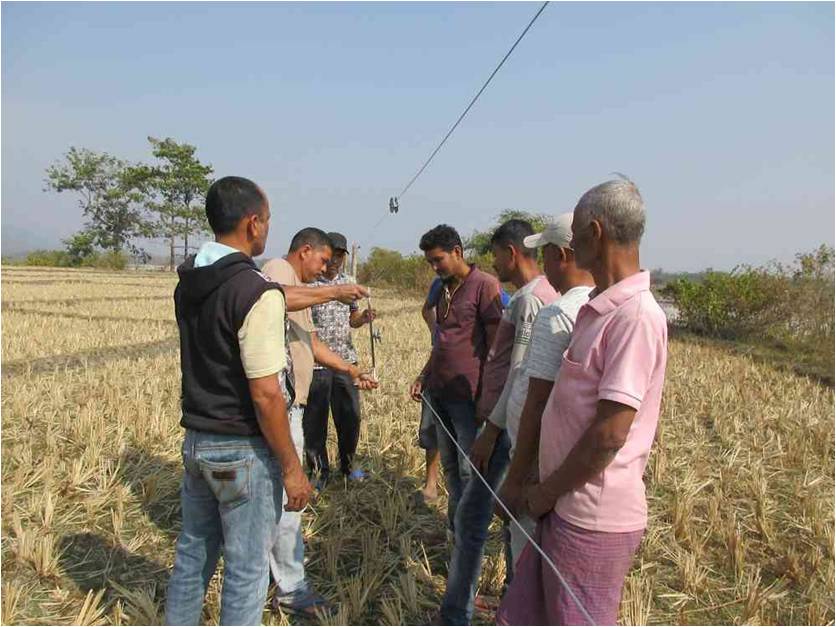
Installing solar-powered fencing
In Assam, the spiritual belief and tolerance of people towards elephants have played a major role in enabling coexistence between both the species. However, with shrinking habitats and increasing human population in the state, the human-elephant confrontations have increased many folds, often leading to undesirable interactions between them. Of late, human-induced elephant deaths using illegal electric fencing powered through mains is on rise in the state.
To resolve this, Elephant Research and Conservation Division (ERCD), Aaranyak intervened in one of the high-conflict areas, Subankhata, on the eastern part of Manas Tiger Reserve (Baksa District, Assam) in 2014. We installed 14-km long solar-powered electric fences, which benefitted approximately1000 households and their crop fields and about 100 odd elephants that occurs in the area. The initiative was a successful one with active participation from the villagers and after six years of its installation, the fences are still functioning. In the last six years, no incidents of elephant or human deaths have occurred in the area. With this pragmatic approach and successful result, we in later years installed few more kilometers of this fences. With the earlier experience, we improvised on our installation process and helped build capacity of the local people on installation and monitoring of these solar fences.
In the last one year, ERCD had installed a total of 24.5 km of solar-powered electric fences in the Baksa district. The fences are installed in such a manner that separates the villages without hampering the passage of the elephants, thus fostering coexistence between both the species. The initiative besides, directly impacting the people by reducing economic losses, also have a significant effect on their social life. During the crop season, most men of the villages were out guarding the crops from the herds of wild elephants. The prolonged deprivation of sleep, approximately of 2-3 months often had negative impact on health, education and social life. Even after the deprivation, there was no assurance that the villagers can save their crops or properties from the wild elephants. The hard work and the sense of deprivation of the already poverty-stricken farmers frequently lead to retaliation. Through our efforts we not only ensured food security, but also social security and aiding conservation of the elephants in the landscape. With this effort, about 10000 households were benefitted.
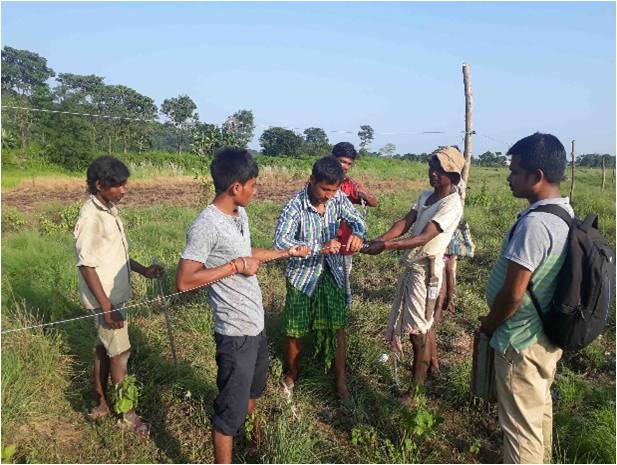 Villagers installing the fencing to safeguard the farms
In a lower primary school in Nagaon, Nam Kamakhya LP School, as many as 18 incidents were recorded where wild elephants visited the school. As a result, students were hesitant to come to school and the teachers were applying for their transfer to other schools. Aaranyak extended its support to the school authorities with generous donations for their collaborators and immediately erected a solar-powered electric fence around the school. In another instance, a 7.5km fence was installed under Kathiatoli Range, Nagaon Wildlife Division, Assam to benefit approximately 3000 households of several villages.
To protect the people, crop and elephants, Aaranyak is ‘buying time’ by installing solar-powered fences, when at the same time working tirelessly for long-term solutions to resolve HEC by securing and restoring the habitats. For the unversed, Aaranyak is a non-profit organization working in the northeast region of India to conserve the biodiversity through applied research, conservation education, building capacity and empowering local communities (www.aaranyak.org).
Acknowledgement
We are grateful to Elephant Family Foundation India, USFWS and Center for Large Landscape, University of Montana, USA
If the story resonates with you, please share
Impact-Story is a series on development and CSR interventions leading to some impacts on the ground. If you have a project, innovation or intervention that has changed the lives of a few people or a community, please share a brief note at csr@ngobox.org. Our Team will get back to you after validating the information for a detailed coverage.

More Stories

CSRBOX is India’s leading CSR knowledge and impact intelligence driven media platform for the development community. It serves as an enabler, encouraging collaboration and partnerships between CSR stakeholders. Here, we connect and inform over three million professionals through our online platform, and bridge information gaps by providing a range of services for Corporate, NGOs and Social enterprises, to enhance their capacities, aid collaboration, plan projects, publish knowledge resources, conduct research, amplify their reach and much more.
Submit CSR News
Please submit your CSR news, CSR impact story ideas to us. Our Team will get back to you within 6-12 working hours. You can also email us at info@csrbox.org© Renalysis Consultants Pvt Ltd. All Rights Reserved | Powered by NGOBOX